Why Most Small Businesses Don’t Need More IT. They Need Better Direction
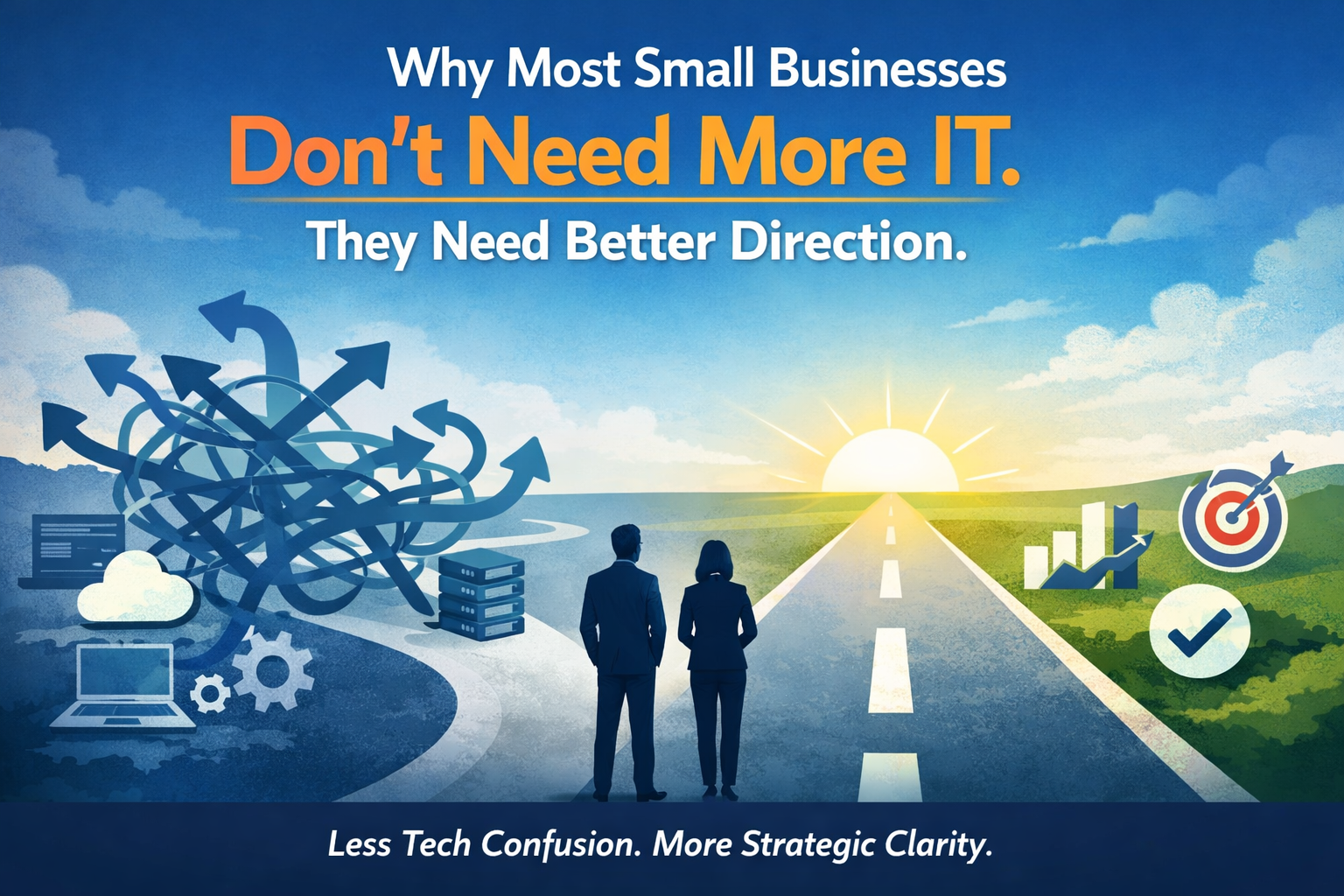
Many small and mid sized businesses believe their challenges can be solved by adding more technology. More software. More tools. More vendors.
In reality, most of the time the problem is not a lack of IT. It is a lack of clear direction.
This is not an argument against technology. The issue is confusion, reactive decision making, and technology that grows without a clear purpose. When systems are added without alignment to business goals, they create complexity instead of clarity.
The Problem With “More IT”
When a business feels stuck or behind, the default response is often to purchase another solution. Something breaks, growth slows, or a new requirement appears, and a new system is introduced to fix it.
Over time, this leads to overlapping tools, disconnected data, and employees who are unsure which systems matter most. Leadership receives more information but less insight. Technology becomes harder to manage, not easier.
The tools themselves are rarely the problem. The issue is that decisions are made without first defining what success looks like.
Reactive Decisions Create Long Term Costs
Technology decisions made under pressure tend to solve short term problems while creating long term ones. Each reactive purchase adds cost, training requirements, and ongoing maintenance. As systems stack up, flexibility decreases and future decisions become more complicated.
Instead of supporting the business, technology begins to dictate how the business operates.
Clear direction helps prevent this cycle by ensuring that decisions are intentional rather than rushed.
Strategy Comes Before Systems
Effective technology decisions start with strategy. Before evaluating tools or vendors, it is essential to understand business priorities, growth plans, and operational challenges.
When goals are clearly defined, technology choices become easier and more focused. Often, the best solution is not adding something new, but simplifying what already exists. This may include consolidating systems, improving usage of current tools, or eliminating redundancy.
Technology should enable the business, not distract from it.
Simplicity Drives Better Outcomes
Smaller organizations have an advantage. They can adapt quickly and avoid unnecessary complexity. That advantage disappears when technology becomes bloated and unmanaged.
A clear direction makes it easier to say no to tools that do not support real business needs. Simpler systems are easier to manage, easier to use, and easier to scale.
Clarity leads to consistency. Consistency leads to momentum.
Better Direction Leads to Better Decisions
Better direction does not mean having every answer upfront. It means asking the right questions before making commitments.
What problem is being solved?How does this support business goals?What is the impact long term?What happens if nothing changes?
When leadership has clarity, technology becomes a strategic asset instead of a constant challenge.
A More Thoughtful IT Conversation
Many businesses do not need another solution. They need a clearer framework for making decisions about technology.
Toledo Consulting helps organizations step back, simplify, and align technology with business goals. The focus is not on adding more systems, but on creating clarity and direction.
If your technology environment feels more complicated than it should, a conversation can help uncover where simplification and better alignment may be possible. Reach out to start a practical discussion about how to make technology work in support of your business.